

What the Employment Act 2007 Says About Redundancy Terminations
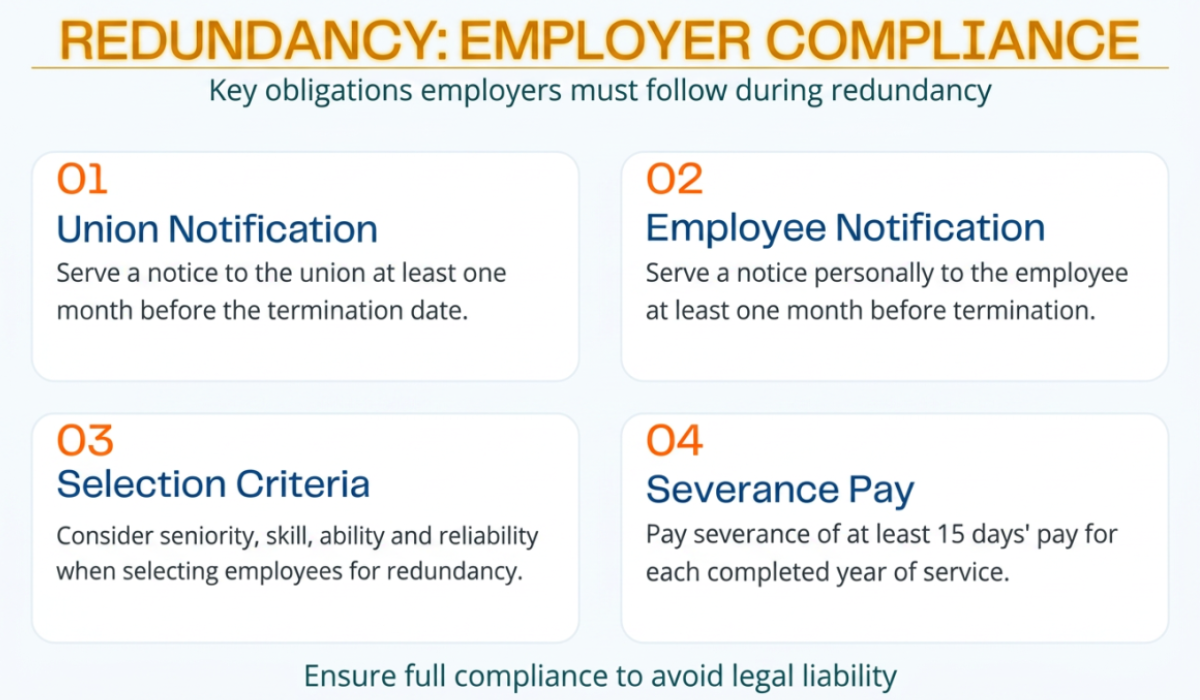
An infographics showing key employer redundancy compliance requirements
By: Kizito Namulanda
Section 40 of the Employment Act 2007 sets out strict conditions designed to protect workers from arbitrary dismissals, safeguard union rights, and ensure fair compensation for those affected.
Redundancy: when it counts as termination under the Act
Under the Act, an employer cannot terminate a contract of service as redundancy unless specific conditions are met. The aim is to prevent opportunistic or punitive dismissals and to give workers time to plan their next steps. In this story, we focus on notification, fairness in selection, respect for collective agreements, and severance pay.
Notification and transparency
If the employee belongs to a trade union, the employer must notify the relevant union and the labour officer in charge of the employee’s area. The notice must explain the reasons for the redundancy and the extent of the intended terminations, and it must be given at least one month before the planned termination date. For employees who are not union members, the employer must provide written notice to the employee in person and also inform the labour officer, again at least one month before termination.
Fairness in selecting who is made redundant
When choosing which employees will be declared redundant, the employer must give due regard to seniority in time, as well as the skill, ability, and reliability of each employee within the affected class. The goal is to balance organizational needs with fair treatment of workers.
Respect for collective agreements and terminal benefits
If a collective agreement exists that sets out terminal benefits upon redundancy, the employer must ensure that employees are not disadvantaged for being or not being a union member. This protects workers from discrimination tied to union status while honoring agreed-upon benefits.
Severance pay
Any employee declared redundant is entitled to severance pay at a rate of not less than fifteen days’ pay for each completed year of service. This acts as a financial cushion during the transition.
Implications for employers
The law encourages early planning, clear communication, and careful documentation. Employers must engage with unions where they exist and prepare explanations of the redundancy rationale and the selection criteria. Documentation demonstrating how seniority, skill, and reliability were considered is essential. Where a collective agreement applies, it should be reviewed to align severance and terminal benefits with its terms.
