

Calling out the Bold Impunity at the Standard Group
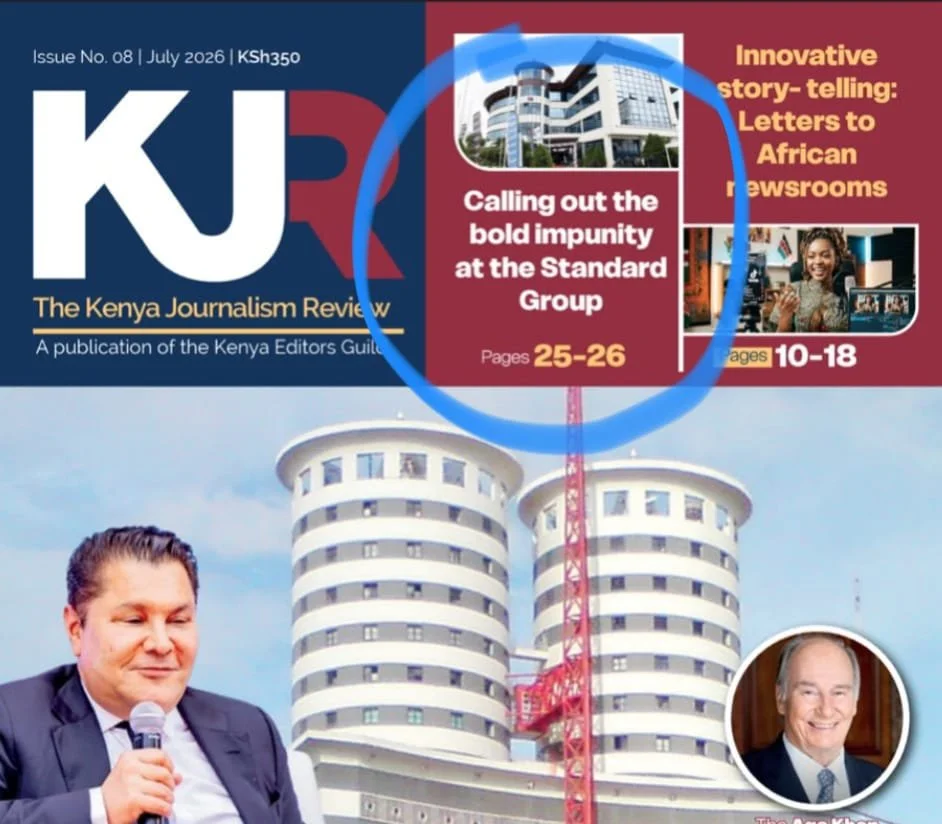
A screenshot of Kenya Journalism Review magazine issue No. 08 July 2026, published by the Kenya Editors Guild (KEG)
Note: This article was first published in Kenya Journalism Review journal (KJR) issue No. 08, July 2026 by Kenya Editors Guild (KEG)
By Kizito Namulanda
When a corporate giant the size of Standard Group — Kenya’s second-largest media house — discards hundreds of staff through Voluntary Early Retirement then follows up with retrenchment rounds in 2023 and 2024 almost immediately, the industry should sit up. When those same episodes are coupled with salary arrears, unpaid final dues, and unremitted statutory deductions, we are not witnessing mere mismanagement; we are witnessing a systemic abandonment of fiduciary duties. Reports that PAYE, NHIF/SHIF, NSSF, pension contributions, and Sacco deductions were deducted from staff payslips but never fully remitted to the authorities or funds point to a chilling betrayal of trust. Tens of millions of hard-earned savings entrusted to the company have evaporated, leaving staff stranded.
Even more disturbing is the method — or the lack thereof — by which retrenchments were conducted. Bedridden staff and others with terminal illnesses were terminated, and to date, they have not received their due entitlements. This is not ordinary corporate pressure; it is an aggression against the vulnerable, a flagrant disregard for human dignity, and a breach of both law and basic decency.
When such conduct surfaces, the industry should be deeply concerned. This is not normal operations. While the crisis has received coverage in the mainstream media, there is a big room for doing more. Some newsrooms have treated it as less urgent than it warrants, and public attention to colleagues’ rights has sometimes seemed tepid. In contrast, bloggers have shown a stronger sense of solidarity and urgency.
It is high time Standard Group answered: what moral authority do they claim to publish bold headlines about government accountability when them themselves tolerate injustices behind closed doors? From the pulpit of public discourse, the question echoes: what business do you have removing a peck from your brother’s eye when you carry a log in your own?
People have died, families have lost breadwinners, and sick staff — unable to find new employment — cannot meet medical costs while Standard Group sits on possibly millions, of shillings owed to them. This is not a private grievance; it is a matter of public interest, human rights, and corporate accountability.
Standard Group’s majority stake — approximately 69 percent — is owned by S.N.G. Holdings, registered in the United Kingdom and associated with Kenya’s second president Daniel Moi’s family. The Moi family should understand that they now have a responsibility, as stewards of a prominent Kenyan institution, to address this matter conclusively. If genuine stewardship and respect for the workforce remain absent, history will judge harshly, recording that they failed to uphold the standards befitting a national legacy.
As the country awaits for a possible next step of action from the owners of Standard Group, urgent questions about staff remedies and the reach of the corporate shield are now being asked, considering the media house has endured this crisis for more than three years without signs of improvement. What remedies do staff have in this kind of a situation? Can directors be held personally responsible, and could the corporate veil be pierced to address systemic mismanagement? If things keep as they are, and without any clear commitment from management to turn things around, then definitely steps to lift the corporate veil will kick in at some point. If leadership remains silent, the case for piercing the veil will grow stronger, not weaker, and the risk of personal accountability for those at the helm will escalate.
Management so far seems focused more on investing in the business and hiring more staff. The argument that quietly sits under the table is that channeling funds into sorting out the staff mess—which was created by ‘someone else’—sinks cost into things that will not show shareholders value for money. Which is really a defeatist argument, because these monies are accruing interest and piling up evidence of continued violations. Should authorities decide to pursue the route of lifting the corporate veil, those funds in arrears will become part of the evidentiary tapestry that points to ongoing mismanagement.
Should the situation escalate to lifting the corporate veil, then we expect exposure to happen at two levels. First at director level – the people who manage the company’s daily operations and strategic direction. They are appointed by the shareholders to run the company, oversee management, administration, and legal compliance, and they bear a legal fiduciary duty to act in the best interests of the company. Second is at the beneficial owner level – this is the person who ultimately owns or controls the company.

An infographic detailing Standard Group staff woes
The recommended remedy for staff is to pursue their unpaid salaries and final dues in the Employment and Labour Relations Court (ELRC). Wage disputes, including salary arrears and retrenchment final dues, fall squarely within the ELRC’s purview. Staff can seek recovery of owed salaries and interest, and retrenchment packages as set out in the Employment Act 2007, which provides for final dues of at least 15 days’ salary for each year of service when an employee is terminated on account of redundancy. Several staff members have already filed cases in the ELRC, while many who cannot afford the court process have been left with no option but to hope for better days ahead. Given the scale, courts may be urged to consider special or exemplary damages to deter ongoing violations and demonstrate that the law will bite where gross non-compliance is proven.
When it comes to statutory deductions, a different enforcement route is adopted. PAYE, NHIF/SHIF, NSSF, pension contributions, and SACCO deductions are not merely contractual obligations; they are statutory or trust-like duties requiring timely remittance to the relevant authorities or funds. Regulators such as the Kenya Revenue Authority (KRA), NHIF, NSSF, and the pension regulators (and SACCO regulators such as SASRA) have enforcement powers, including notices, penalties, and orders to recover funds. In persistent non-compliance, regulators can pursue director liability or disciplinary action. KRA has already acted, leading to the freezing of Standard Group accounts in past to recover unremitted deductions, while SHIF and NSSF are understood to be taking initial enforcement steps.
It is against this backdrop, that the question of piercing the corporate veil—lifting it— enters the frame. Kenyan law treats the corporate form as a shield designed to protect directors and shareholders from personal liability. Yet the shield is not impenetrable. The Companies Act 2015 contemplates disqualification of directors for “unfitness” (Section 225), and the court, the Attorney General, or the Official Receiver may act if a director’s conduct shows persistent unfitness or other misconduct. The Insolvency Act provides a parallel route through wrongful trading (Section 506), allowing directors to be held personally liable for contributions to the company’s assets when the company trades while insolvent or continues to incur unpayable debts.
In the realm of taxes and payroll, deliberate non-remittance of deductions can expose directors to personal liability under the Tax Procedures Act when applied together with the Income Tax Act. Related SHIF/NSSF provisions and provisions in the Penal Code contemplate criminal liability for fraud or theft where employee deductions are misappropriated. Money deducted from an employee’s salary is not supposed to be used as operational cash flow.
Yet piercing the veil is not a routine remedy. It is usually invoked as a last resort, only when evidence demonstrates deliberate mismanagement, concealment, or a façade of corporate form masking wrongdoing. The central question, therefore, is whether the pattern of violations at Standard Group—years of salary arrears and unremitted deductions, if proven, forms a composite picture of governance failure and potential unfitness. Regulators might use such a record to argue for disqualification of officers under Section 225, while tax and social-security regulators could pursue personal liability where willful non-remittance is established.
The stakes could not be higher: hundreds of staff are owed redress, regulators are watching, and the corporate form that once enabled enterprise now tests the limits of accountability. If Standard Group drifts toward inaction, the question won’t be whether the veil can be pierced—but when, by whom, and whether its keepers have earned the right to wear it. Action must come now, or the shield that once protected growth will be exposed as a shield for impunity.
