

Beyond the Town Hall: The Questions That Will Define SHA’s Success.
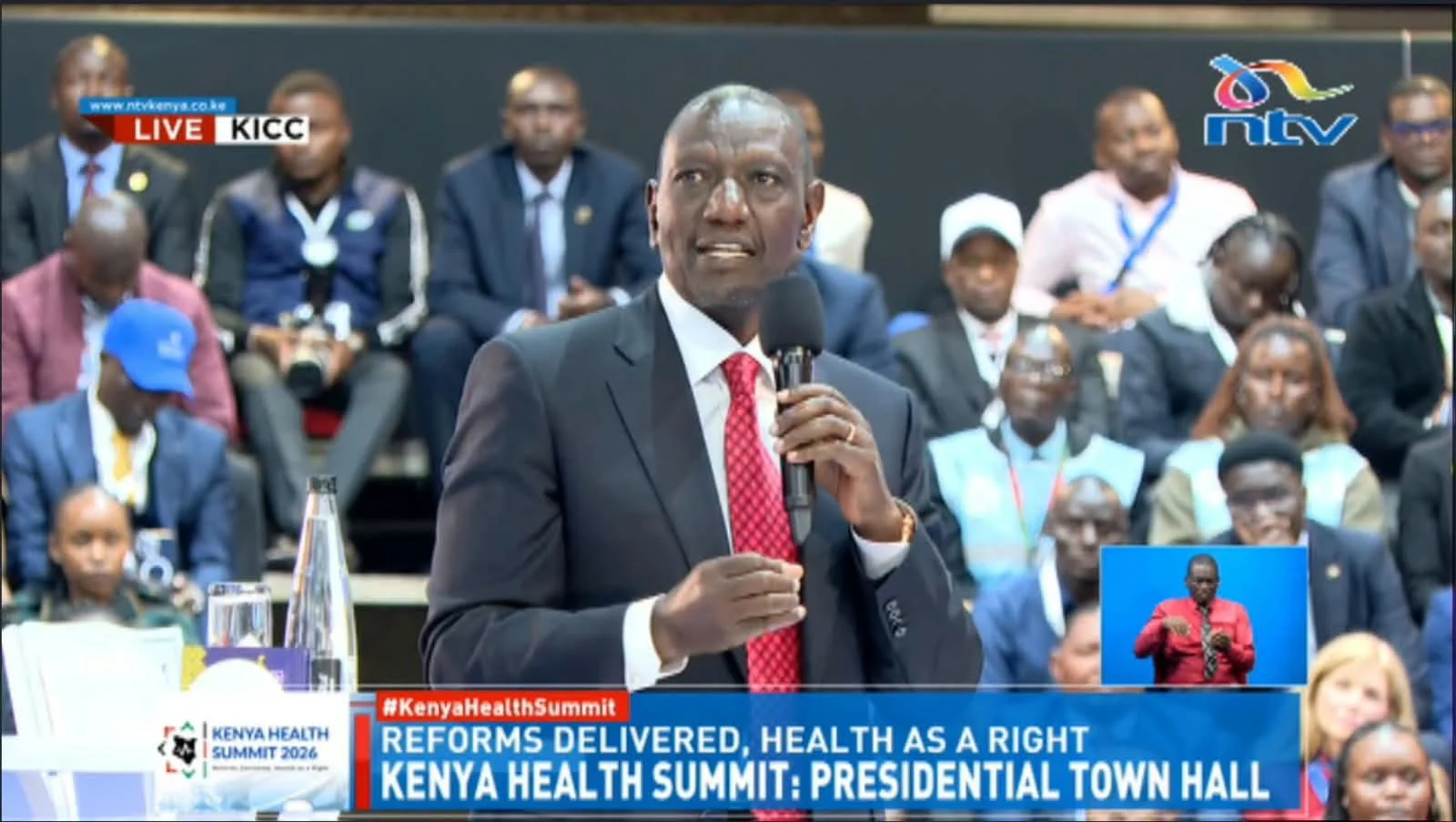
President William Ruto addresses the audience at the Kenya Health Summit during a presidential town hall on health reforms at KICC. Photo: Courtsey
By Kizito Namulanda
The Presidential Town Hall on the health sector, held at the Kenyatta International Convention Centre (KICC) on Tuesday, August 18, 2026, was an important attempt to demonstrate accountability. It placed the President and his administration at the centre of a conversation about one of the most consequential reforms of his government: the transition from the National Health Insurance Fund (NHIF) to the Social Health Authority (SHA).
For a President who made universal health coverage and health sector reform a major campaign promise, the decision to publicly answer questions about delivery is welcome. Leadership should not end with making promises during campaigns. Leaders must also return to the people and account for the mandate they were given.
That is what makes the idea of Presidential Town Halls important.
But there is a difference between holding a public event and creating a genuine accountability forum. A true accountability forum must allow citizens to confront those in power with difficult questions, hear honest answers and demand action where things are not working. That is where the health town hall left some important gaps.
The message was clear: SHA is working
Watching the event, there were moments when it appeared carefully designed to communicate one central message: SHA is working
The audience brought together government officials, county representatives, health facilities, healthcare providers and beneficiaries. Patients shared positive experiences while providers spoke about progress under the new system. Those stories matter. Kenyans who have genuinely benefited from SHA deserve to be heard.
But a national health system serving more than 30 million people cannot be declared successful simply because a number of beneficiaries say they are satisfied. Neither should registration numbers alone be treated as the ultimate measure of success. Registration represents an expectation.
When a Kenyan signs up and contributes to a health insurance system, they expect healthcare to be available when they need it. The real test comes when that person walks into a health facility and attempts to use the cover.
Can they access the service? Does the system work? Can the hospital confirm eligibility? Are the promised services covered? How much must the patient pay from their own pocket? And when the system fails, what happens to the patient? Those are the parameters that should define success.
A system can have millions of registered members and still fail many of them at the point where healthcare is needed most.
The controversies cannot be wished away
Since its rollout, SHA has faced criticism from contributors, healthcare providers, patients and other stakeholders.
One concern is the financial burden. Formal sector employees contribute 2.75 per cent of their gross income, without the upper contribution ceiling that existed under NHIF. For many middle- and high-income earners, this has meant higher monthly deductions.
Then there is the means-testing model for households outside formal employment. Assessing a person's ability to contribute may be reasonable in principle. But if the system overestimates incomes or assigns contributions that poor households cannot afford, those who most need healthcare protection could find themselves excluded by the very system designed to protect them.
There are also concerns about benefits. Some Kenyans have complained about limits on treatments, specialised procedures and diagnostic services, while others have incurred significant out-of-pocket costs despite being registered contributors.
A health insurance system should protect people from being pushed into poverty by medical bills. If contributors still have to raise substantial amounts before accessing treatment, questions about the protection offered by the system become unavoidable.
Technology presents another concern. Health facilities have raised issues around system downtime, portal failures and difficulties with digital platforms. When technology fails at the point of care, the consequences can be serious.
A patient may be asked to pay cash. Treatment may be delayed. A facility may be unable to confirm eligibility. In an emergency, a system outage can become a matter of life and death.
These concerns cannot disappear because a well-organised town hall produces positive testimonies. They require evidence, facts and clear answers.
A town hall should interrogate power
Perhaps the biggest weakness of the health summit was its structure.
A forum organised around the President, with participants brought together for the occasion and broadcast live before the nation, can easily become an event where few people are prepared to openly contradict the Head of State.
That danger appeared visible during the discussion around concerns allegedly raised by a senior figure at Karen Hospital. The President sought to establish the facts and asked that the person be contacted and placed on loudspeaker. The organisers initially struggled to reach him before eventually getting through to another senior official from the hospital, who dismissed concerns about SHA and said the facility was operating well under the system.
Whatever the truth of the competing claims, the episode illustrated the limitations of trying to resolve complex national issues through spontaneous phone calls and live interventions.
The President should not have to establish whether SHA is working through such exchanges. His administration should already have the data – and the public should have access to it.
Take the conversation to the bottom
If Presidential Town Halls are to become a permanent feature of government accountability, future summits should consider adopting a more bottom-up approach. The national event should be the climax of a much broader national conversation, not the starting point.
Before the President sits before cameras in Nairobi to discuss a sector, citizens, workers, patients, professionals, businesses, civil society organisations and service providers should be given structured opportunities to identify the problems they face.
In the healthcare sector, for instance, evidence should be collected from dispensaries, health centres, county hospitals and referral facilities across the country.
Patients should share their experiences. Doctors and nurses should explain what works and what does not. Hospitals should present evidence of payment delays and system failures. Counties should identify operational challenges. Contributors should explain whether deductions are affordable and whether they receive value for their money.
That information should then be compiled into a national issues report ahead of the Presidential Town Hall. By the time the President takes the stage, he should not be asking whether there are problems. He should already know them.
The summit should then answer: What has been fixed? What has not been fixed? Why? Who is responsible? What will be done next, and by when?
That would turn a Presidential Town Hall from a public relations event into a genuine instrument of accountability.
Let independent media lead the interrogation
There is an even stronger option. If the President is confident about his government's performance, he should consider placing himself and his team before an independently moderated national town hall.
Let Kenya's leading media houses jointly provide a panel of experienced interviewers and moderators. Let journalists develop the questions. Let citizens submit issues from across the country. Let experts interrogate the data, while healthcare workers and beneficiaries challenge the answers where necessary. The government should provide the facts and respond as the media guides the interrogation.
All in all, President Ruto's decision to hold national conversations on key sectors is a welcome step towards greater accountability that should be strengthened and not reduced to a platform for celebrating government achievements.
The real question is whether, when a Kenyan falls sick, they can walk into a hospital and access the healthcare they were promised without being turned away, forced to pay unaffordable bills or defeated by a failing digital system.
That is the test that matters. And that is the question every Presidential Town Hall should ultimately seek to answer.
Send feedback to:editor@kolleanews.com
_________________
Kizito Namulanda is an experienced Narrative Strategist and Communications Consultant with many years of experience in Broadcast and Digital Media Management. He is the Founder and Editor of Kollea Hub.
