

Who Won the Linda Mwananchi Homa Bay Fiasco?
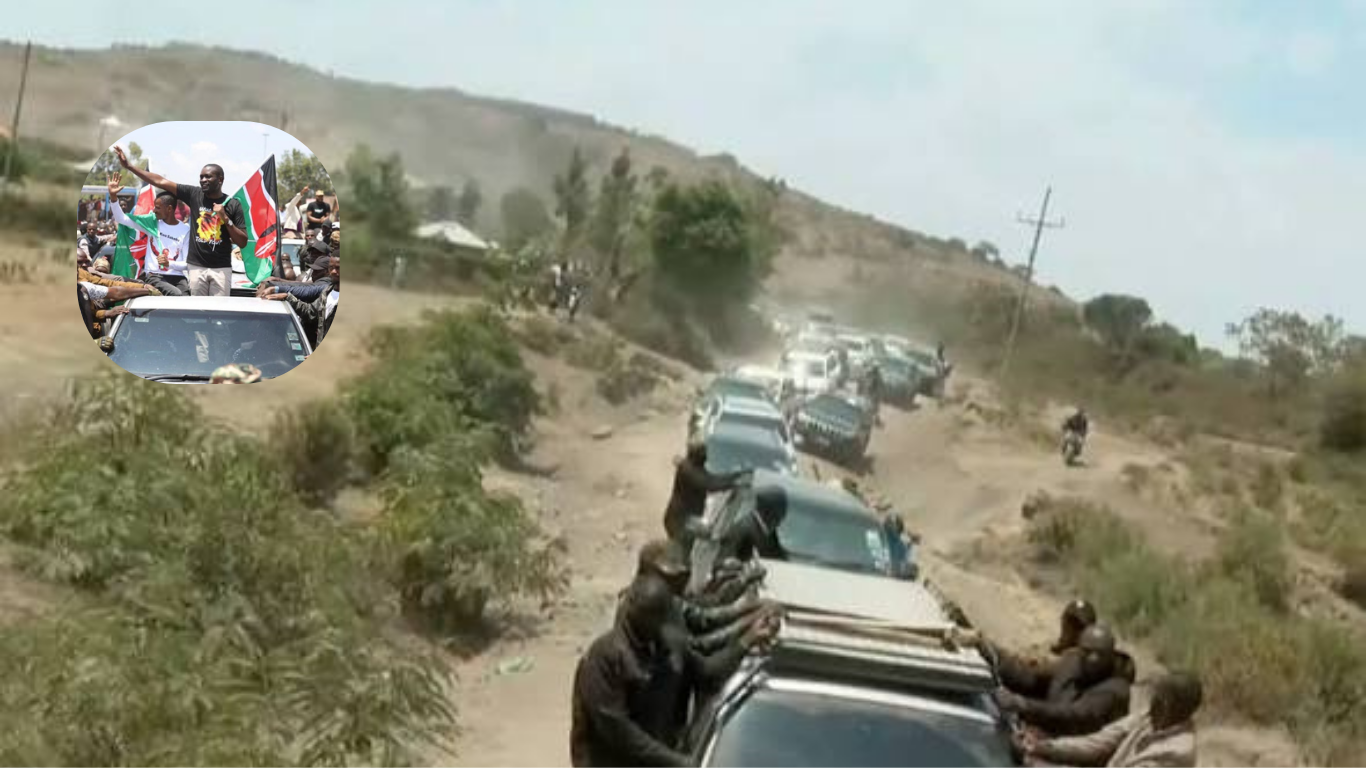
Linda Mwananchi supporters make their way through dusty rural roads during the movement’s political tour of Homa Bay County.
By Kizito Namulanda
Immediately after a highly successful homecoming rally in Bungoma, the Linda Mwananchi brigade announced that its next political stop would be Homa Bay County. It was always going to be an important test.
The movement, led by Nairobi Senator Edwin Sifuna, emerged from divisions within the Orange Democratic Movement (ODM) following the death of party leader Raila Odinga. One faction, associated with Sifuna and supported by prominent leaders who have questioned the direction ODM has taken, broke away from the other faction led by Siaya Senator Oburu Odinga. Oburu's faction has remained committed to the broad-based government arrangement in which Raila left the party before his death.
The battle for the political soul of Luo Nyanza is, therefore, no longer a matter of speculation. It is now unfolding in public.
Homa Bay, home to Governor Gladys Wanga and one of ODM's traditional strongholds, was expected to provide an important indication of where the political ground is shifting. President William Ruto and his allies have increasingly looked to Nyanza as a potentially crucial source of votes ahead of the next General Election. The broad-based camp, on the other hand, has projected confidence that ODM still retains firm control of the region.
That confidence was put to a serious test during the Linda Mwananchi tour.
The scenes witnessed over the weekend were dramatic. Barricades were erected along roads leading to towns where the Sifuna-led team planned to hold rallies, forcing the group to struggle to access its intended venues. Yet, despite the disruption, Linda Mwananchi received warm receptions in Nyandiwa and Sindo, where large crowds turned out to cheer the team. Even when the group arrived in Homa Bay town at dusk, supporters were still waiting.
The two sides have naturally interpreted the events differently.
Linda Mwananchi argues that the disruption itself was evidence that its opponents are worried about its growing influence. From its perspective, there was an attempt to stop the team from reaching the people because its message is beginning to find an audience in territory its opponents have long considered their political backyard. The receptions in Nyandiwa and Sindo, as well as the crowds that waited for the team in Homa Bay, will be cited as proof that there is a constituency willing to listen.
The broad-based government side has offered a different explanation. Some leaders have argued that the barricades were stage-managed to create drama and generate sympathy for Linda Mwananchi. They will also point to the fact that elected leaders from Homa Bay County stayed away from the tour. Their argument will therefore be that political visitors cannot simply enter Homa Bay and dictate the direction or tempo of politics in the county.
Both sides have arguments to make. But when one looks at the events objectively, the biggest question is this: Who benefited from the drama? The answer, at least politically, appears to be Linda Mwananchi.
If the barricades were genuinely erected by opponents of the movement, then the strategy backfired badly. The images of a political team struggling to access its venues and being forced onto dusty and rough rural roads created a powerful narrative: that Linda Mwananchi was being denied the freedom to meet the people.
Whether that narrative is entirely accurate or not may remain a subject of political debate. But politics is often about perception, and in Homa Bay, Linda Mwananchi walked away with the more compelling story. Its leaders can now say: They tried to stop us, but the people still came out. That is a message that could travel far beyond Homa Bay.
And if, as the broad-based camp alleges, the barricades were stage-managed by Linda Mwananchi, then the broad-based side still has questions to answer. Why did it allow the drama to play out unchecked?
If the movement was indeed manufacturing a political spectacle, the easiest way to expose the alleged scheme would have been to ensure that the roads remained open and the rallies proceeded peacefully. The broad-based side is closely associated with the government and has significant political influence in the region. It could have publicly called for calm, urged young people not to block roads, and ensured that the visiting leaders received adequate security to access their venues.
A peaceful Homa Bay tour would have denied Linda Mwananchi the victimhood narrative it now carries. Instead, the disruption became the story.
The broad-based camp may have succeeded in showing that local elected leaders were not prepared to embrace the Linda Mwananchi tour. But its opponents will ask an equally important question: Must elected leaders attend a rally for ordinary people to turn up?
The warm reception in Nyandiwa and Sindo suggests that the political contest cannot simply be measured by the positions taken by governors, MPs and other elected leaders. A political movement may lack the support of the establishment while quietly building a connection with voters on the ground. That should worry the ODM leadership.
The Homa Bay episode also raises serious questions about the assumption that Luo Nyanza has already been delivered to President Ruto and the broad-based government. There have been increasing claims that the region is firmly under the control of the ODM faction working with the government. That confidence has reportedly informed demands for a significant share of government, including calls for a major stake in future political arrangements. But Homa Bay should serve as a warning against overconfidence.
The loss of influential figures from the broad-based camp has clearly complicated matters. Leaders such as James Orengo and Babu Owino command their own political following and cannot simply be dismissed. Their association with the growing resistance to the current direction of ODM has created a political problem that the Oburu Odinga-led leadership can no longer wish away.
The real mistake may have been to underestimate the consequences of losing such influential voices.
For Oburu Odinga and the ODM leadership, the lesson from Homa Bay is not necessarily that Linda Mwananchi has already won Luo Nyanza. It has not. The region remains politically fluid, and one rally cannot settle such a major political contest.
But neither can ODM and the broad-based camp claim that the ground is firmly under their feet while ignoring the discomfort caused by the Linda Mwananchi movement.
For President Ruto, the events should equally trigger a review of his political calculations. If the expectation is that Luo Nyanza will deliver a reliable vote basket to his side, then the divisions now emerging within the region must be taken seriously. The political ground may not be as settled as some of his allies would like him to believe.
So, who won the Homa Bay fiasco? Linda Mwananchi won the optics.
The movement may not have won political control of Homa Bay. The broad-based side still has the advantage of established party structures, elected leaders and influence within government. But in the battle for public attention and political narrative, Sifuna's team emerged stronger from the chaos.
The barricades, whoever was responsible for them, handed Linda Mwananchi an opportunity to portray itself as a movement being resisted because it is becoming a threat. The crowds that turned out in Nyandiwa, Sindo and later Homa Bay gave the movement enough political material to reinforce that message.
The broad-based camp, meanwhile, has been left explaining the drama. And that is perhaps the biggest lesson from the Homa Bay tour: In politics, you do not always win by stopping your opponent. Sometimes, the attempt to stop them gives them exactly the victory they were looking for.
As the literal dust settles on the rough roads that Linda Mwananchi was forced to use, and the political dust settles on a dramatic weekend in Homa Bay, both President Ruto and the Oburu Odinga-led ODM leadership may need to return to the drawing board.
The battle for Luo Nyanza is far from over. And if Homa Bay is anything to go by, it may be much more competitive than they had imagined.
Send feedback to:editor@kolleanews.com
